All African Conference of Churches (AACC) organised its 11th General Assembly on 1-7 July at Kigali, Rwanda. The conference attracted more than 800 participants across the African continent, including international partner organisations.
This year, the AACC General Assembly showed the importance and the need to invest in ethical education for the church-based organization leaders and to achieve the self-sustainability of the institution while remaining faithful to their values in a world of constant change. The Globethics.net strategy on ethics in higher education was thematically relevant to the conference; this is why Globethics.net featured as a key guest at the AACC 11th General Assembly, participating in three presentations conducted by Globethics.net Executive Director, Obiora Ike.
In the week before the General Assembly, over 100 young theologians came to reflect on the theme and sub-themes in preparation for the 11th General Assembly. Globethics.net was invited, along with other partners such as Bread for the World, Act Alliance, and World Council of Churches, to deliver lectures to the theological students. At the General Assembly, Globethics.net also played an active role.
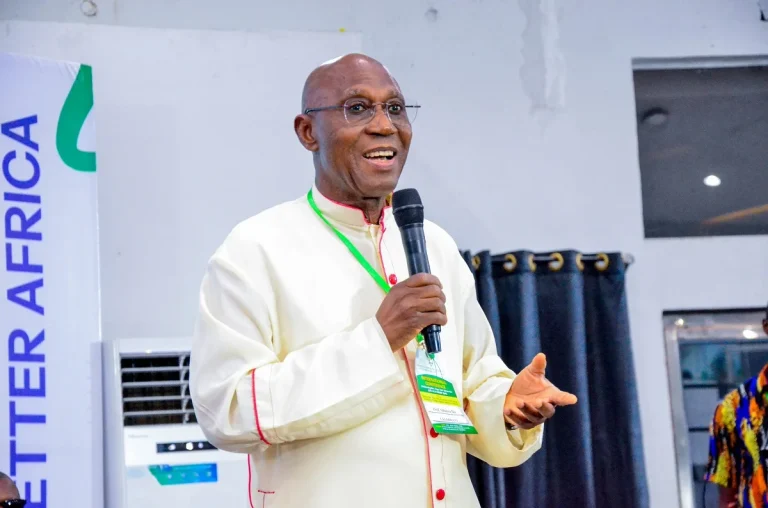
At the plenary session, Obiora remarked on the importance of strengthening the ethical investments of church-based organizations and how it is linked to education. He showcased Globethics.net, AACC, Bread for the World Project, African Church Management (ACAP), as an example of working with these institutions and offering them capacity development to improve their institutions’ asset management. Taking the opportunity that all the organisations involved in this project were present in the room, Obiora launched the ‘African Church Assets Handbook’. It is a Globethics.net Publication which offers conceptual knowledge, practical solutions and case studies written by practitioners for practitioners in churches on how to manage ethically the institutions assets. To finalise his presentation, Obiora announced that after having successfully overseen two runnings of ACAP (ACAP I and ACAP II), there was going to be a third version, ACAP III, and invited the present theological institutions to join it.
One of Obiora’s lectures to the theological students focused on corruption and the role of churches in Africa to fight corruption. ‘The solution to stop from being a constant beggar to become self-reliance or even a donor is to educate church based organisation’s leaders on how to manage the resources ethically and how to invest in ethics and values’ – this was one of the concepts shared by Obiora on his second speech where he addressed the question: how institutions can move from move from dependence to interdependence?