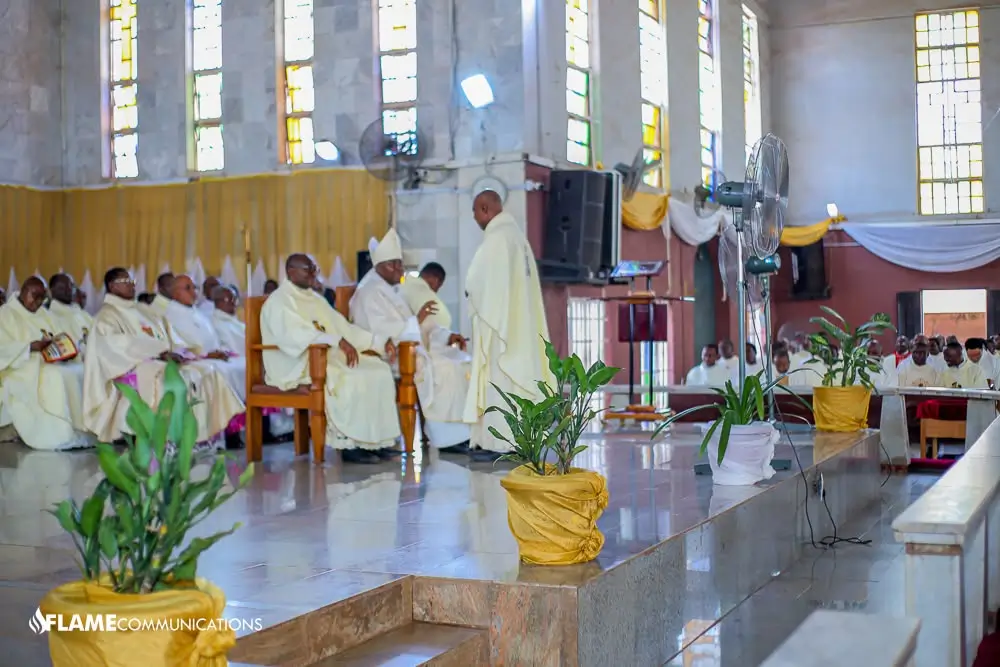
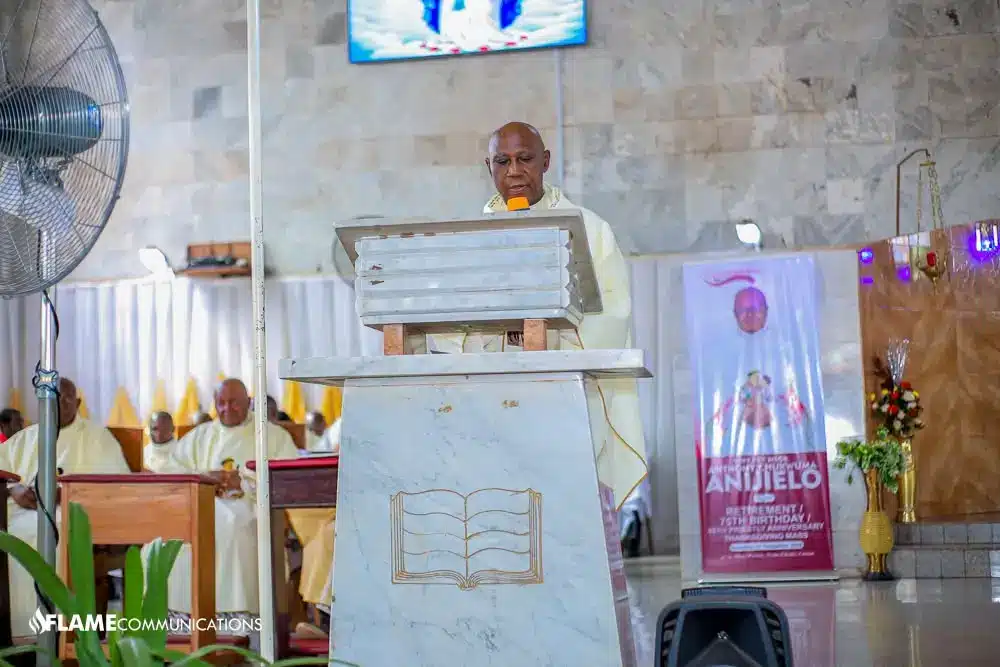
HOMILY AND REFLECTION ON THE LIFE AND TIMES OF MSGR ANTHONY CHUKWUMA ANIJIELO @ 75 AND PRIESTLY ORDINATION ANNIVERSARY @46
Delivered by Msgr. Obiora Ike at St. Mary’s Catholic Church, Trans Ekulu, Enugu, on 14 November, 2026
1. Grace and Gratitude for the Priestly Vocation as Testimony: A Tribute
It is grace, and indeed a noble distinction in the life of the Church, when the vocation of a priest becomes testimony. The marking of the forty-sixth (5 July 1980 to 2026) anniversary of priestly ordination and the official Retirement birthday celebration of the Very Rev. Msgr. Dr. Anthony Chukwuma Anijielo is not merely a commemoration of years lived; it is the celebration of a vocation consciously embraced, faithfully nurtured, and fruitfully fulfilled. It is a tribute to a priest whose life, time, and work have been intentionally aligned with the divine call to priesthood. Upon his priestly ordination in Hambach, Germany, where I was privileged to serve at the altar and mass on 5th July 1980, I handed him my book present of a book titled: “The Priest is a Man for Others” – Chosen from Among Men. It finds its deepest pitch and resonance in the life of the man in whose honour we have gathered today.
Msgr. has embodied the profound truth expressed in the Letter to the Hebrews: “Every high priest is taken from among men and appointed to act on behalf of men in relation to God” (Heb. 5:1). His priesthood has never been an abstraction, nor a mere ecclesiastical function; it has been a lived reality: humane, altruistic, compassionate, intellectually vibrant, economically productive, pastorally courageous, and spiritually rooted.
2. Authentic Priesthood Begins in Intestinal Interiority
From the earliest stirrings of his vocation, there has been an unmistakable intentionality, a conscious and reflective “yes” to the call of Christ. Like the Socratic injunction “Know Thyself,” Chukwuma Anijielo has demonstrated that authentic priesthood begins in interiority—a deliberate self-interrogation that defines much of his thinking and actions.
His life reveals a man who has continually sought self-knowledge from God, allowing grace to shape his identity and mission. In doing so, he has shown that priesthood is not primarily about activity—building magnificent edifices and overemphasizing bureaucratic concern but about configuration— being conformed ever more deeply to Christ, the Eternal High Priest.
3. Spans of Active ministry – Christ as Compass in Living out the Vocation:
“Through Him and With Him and In Him” is our doxology at Mass during the Liturgical sacrifice. Msgr.’s decades of life have unfolded within the dynamic tensions of history—ecclesial, local, national, and global. Yet in each epoch, his priestly identity has remained the compass of his engagement. Whether at Innsbruck or in Germany, where he studied and served, at the catholic Secretariat Enugu or at Bigard Seminary, where he lectured students, as Vocations director or as Vicar for Priests, as parish priest or administrator, in pastoral ministry, intellectual discourse, economic empowerment advocacy for justice and human dignity, interreligious dialogue, or educational leadership, his actions have not been random or reactive. They have flowed and circulated from a coherent center: the conviction that he was chosen not for himself, but for Christ and for others. Over these years, his priesthood has been shaped by prayer, scholarship, pastoral sensitivity, and prophetic courage. He has understood that to be chosen is not to be removed from the world, but to be sent into it with clarity of purpose. At a time when priesthood is sometimes misunderstood or reflects an overemphasis on administrative, operational, functional, or perfunctory social work or politics—Msgr. Anijielo’s life stands as a reminder that the priest is first and foremost configured to Christ—Priest and Victim—called to stand before God on behalf of the people and before the people on behalf of God (Heb. 5:1).
Msgr.’s ministry reflects the inseparability of priesthood and service. He has acted in persona Christi capitis (in the person of Christ the head) not only at the altar but in the marketplace of ideas, in the defense of human rights, in the formation of young minds, in socio-cultural and human development, and in the accompaniment of souls. The Eucharistic center of his priestly life has radiated outward into every sphere of his engagement. Thus, I can be so bold as to say that his life illustrates a profound theological truth: that when a priest intentionally aligns his entire being with his vocation, his word becomes edifying, his time becomes sacrament, his work becomes offering, and his life becomes mission.
4. 75 YEARS and Legacies Counting:
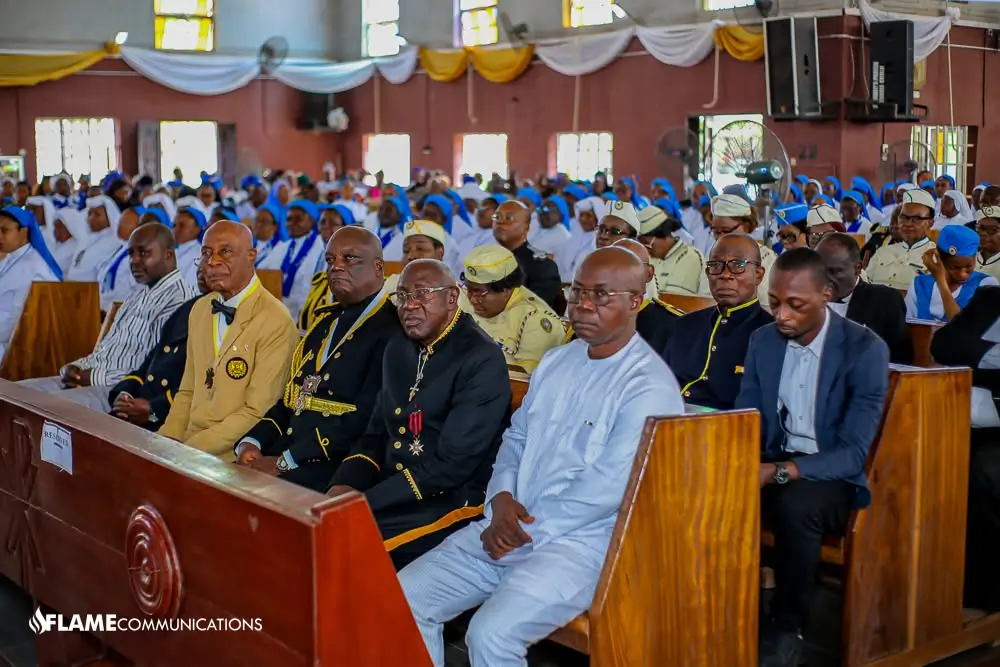
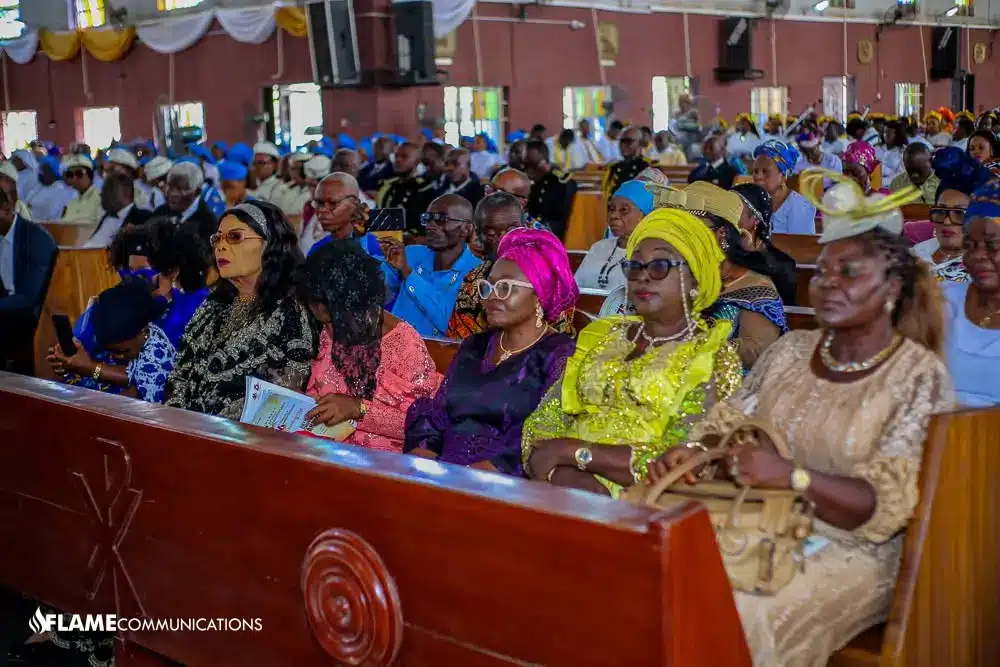
To celebrate seventy-five years is to create a legacy; to mark forty-six years of priesthood is to extol fidelity—fidelity to prayer, fidelity to the call, fidelity to faith, fidelity to truth, fidelity to the mission of the Church, and fidelity to the human person created in the image of God. And above all, fidelity to the One who said, “You did not choose me, but I chose you” (Jn. 15:16). Anthony’s Legacies are many and the priests here present, the numerous seminarians and parishioners, can testify to this as the mirror held up to a life that exemplifies its overarching thesis: that the priest is indeed chosen from among men, shaped by grace, and sent back to men as a sign of God’s enduring love. In honouring him, we celebrate not only his achievements, but his inexorable union with the Church on so many fronts, and his deliberate, sustained, and joyful conformity to the call of Christ.
At a time when mentors and models are few, he remains an inspiration to priests, sisters and religious, a guide to seminarians, and support to the faithful to rediscover the beauty and seriousness of vocation, for each of us is called to be like Christ. His one message is that when one fully entrusts oneself to the divine call, one’s years are not merely counted—they are hallowed, consecrated and magnified. With gratitude for a life given, and with hope for more years yet to bear more fruit, we commend gratefully his work and times to his creator, parents, family, compatriots, teachers and the Church that has produced such a fine and refined gentleman. For our times and clime, he truly followed the path of the teaching and meaning “to be chosen among people, sent back to people in the things that concern God “.
5. A Reflection on the Priesthood of Christ as Victim and Solution to the Crisis of Today:
Quite frankly, the Old and New Testament Priesthood share a lot of similar models, but Christ brought something unique, unrepeated, and permanent in the nature and identity of the Priesthood – the aspect of Victimhood. Christ is both the Eternal High Priest and yet the Eternal Victim. All those who are baptized into him necessarily share in this victimhood.
“Chosen from Among Men” is not simply another treatise on the nature of the Catholic Priesthood. It is the unveiling of a mystery: how God takes an ordinary human life, breathes upon it, and makes it a bridge between fear and hope, injustice and truth, death and the stubborn triumph of grace. Priesthood, in its deepest meaning, is never an escape from the world. It is an immersion into its wounds. The priest stands where human frailty trembles and where divine mercy insists. He belongs to God, yet he is given to people. He carries their burdens, their confessions, their betrayals, and their dreams. He speaks uncomfortable truths. He risks misunderstanding. Sometimes, he risks everything. And sometimes, the cost becomes terrifyingly real. This is Christ himself, the Emanuel (God among us) who came that we may have life and have it in abundance. He became a victim, that we may be sanctified. He suffered for our salvation. Likewise, the Priest.
In recent history, the story of the Popular Bishop of El Salvador, Oscar Romero, in 1980 remains a testament that martyrdom is a consequence of fulfilling the prophetic mission—of denouncing social evil and the culture of death, of injustice, oppression, violence, and announcing the Gospel of love, peace, justice, and liberation.
6. My Personal Story Confronting Assassination and Death by Faith and Divine Grace:
The night of 18 October, 2002 still whispers through memory. Darkness had settled with an unusual weight. The air itself seemed to know that history was approaching on quiet feet. Men arrived—strangers, armed not only with weapons but with orders. They had come with a message sharpened by politics and fear: they were sent to end the life of a priest whose voice refused to bend, whose conscience would not be negotiated, whose loyalty to truth disturbed the comfortable arrangements of power. The accusation was simple: he spoke truth to authority. And for that, he must die. How fragile a human life can appear in such a moment. How small a house feels. How loudly the heart can beat. Yet what followed did not belong to the logic of violence. It belonged to God.
I did not run. I did not bargain. I did not curse the darkness or plead for escape. Instead, I made a request as astonishing as it was priestly: Give me time to go to the chapel and pray. In that sentence lies the soul of the priest – victim and sacrificial.
Before fear, prayer.
Before death, surrender.
Before hatred, communion.
The assassins waited. What passed between a priest and his Lord in that chapel will remain sacred ground, known fully only to heaven. But we can imagine the offering: a life already given many times over now placed again upon the altar. No drama. No spectacle. Simply a servant ready to be faithful to the end.
Here stands the mystery of victimhood—not defeat, but gift. Something changed. Perhaps it was the courage. Perhaps it was the silence. Perhaps it was the strange disarming power of a man who had already accepted the worst and therefore could no longer be controlled by it. When it was settling, the assassins, dressed, sadly, in priests’ robes and who were sent to kill me, looked upon me differently. The hardness had cracked. The mission dissolved. Words emerged that sounded almost like confession: “You are a good man. We know you. We shall not kill you. XYZ sent us to kill you, but we did not even see you”. And they left. Violence retreated. Life continued. But nothing would ever be ordinary again. If only Anthony Chukwuma Anijielo would enumerate the many incidents of such times in his life, and if many of the brother priests here present would give their own testimony, fear would disappear in our world.
Such encounters in our priestly life help reveal its ancient face. The priest is not merely the one who performs rituals. He becomes offering. He stands in the space where death threatens and says, if it must come, let it find me faithful. Such lives preach louder than homilies. They convert without argument. They awaken consciences long thought asleep.
History often celebrates victories won by force. The Gospel, however, recognizes another kind of triumph—the conversion of the human heart. For me, on that night, blood was not shed, yet sacrifice was real, echoing the bloodless sacrifice of the Eucharistic Jesus in our daily Mass. The priest had stood ready. He had accepted the cost of truth. In doing so, he revealed the quiet authority of discipleship.
To be chosen from among men is to be returned to them as sacrifice, service, and sign. To be chosen from among men is to go beyond the cultic model of priesthood and live according to the broader and integral model of the ordained ministry as promoted by Vatican II.
We honor a shepherd who did not abandon the field when wolves gathered. We honor a heart that trusted prayer more than power.
Many will remember the scholar, the administrator, the advocate for justice, the international voice. But beneath all these stands the man of the chapel—the priest whose first instinct in the face of death was to kneel. For in celebrating Monsignor, we are reminded of what priesthood can be at its most radiant: a life transparent enough that, even in mortal danger, others glimpse God.
You are encountering the price and beauty of standing where Christ stands—between the wound and the healing, between the threat and the miracle.
7. ANTHONY ANIJIELO INVITES US THROUGH HIS LIFE TO BEAR OUR CROSS
His life is like an invitation to speak silently or loudly where and when we must. To serve as servants, yet leading humbly but firmly. To speak truth to power, even when we are a minority and alone in our choice or voice, and this has happened many times over. To pray fervently and regularly, as this is one priest who took his Breviary seriously, and the much I know our priests, remains one of the very few of the 15 percent who pray their daily Prayers of the Church and the Divine Office. The rest 75 percent, settle it off with work and work and what Pope Paul VI calls the IDOLATRY OF WORK over GRACE. We are consoled that even in our times and clime, the Lord still chooses from among men. And through such chosen lives, He continues to save.
8. THE MAN WE CELEBRATE – HIS BIRTH AND LIFE AND STORY
It is expedient that we reflect on the mystery of the man chosen from among men to represent Jesus Christ, especially as we celebrate the 46th Priestly Anniversary and 75th Birthday of Very Rev. Msgr. Anthony Chukwuma Anijielo, whom I have known and encountered for 57 years since 1969. We first met at the height of the tragic Biafra war in 1969 as Enugu diocesan seminarians in exile and being admitted as internally displaced persons (IDP’s) at All Hallows Seminary, Onitsha, then also in exile at St Peter Claver Umunuko, Ukpor; then back to our diocesan school, St John’s Seminary, Nsukka at the end of the war – counting our losses of lives and materials and resources and time – (WAR IS NEVER GOOD AND THERE IS NEVER A WINNER). Being ahead of me both in age and in class and as our model in diligence, prayer, discipline and demeanor, we met again at Bigard Memorial Seminary, a regional meeting place of encounter for peoples of all backgrounds and language groups and setting from Cameroon to Liberia and Sierra Leone and of course, the dioceses of the entire eastern region, now encompassing Calabar and Owerri and Onitsha ecclesiastical provinces. Last year, we celebrated Bigard at 100. The journey of life continued with further studies as seminarians and clerics abroad in Innsbruck and Germany. He was our prefect and leader, and in doing studies, learning the German language, and confronting foreign cultures and peoples, his constant advice and compass helped many of us focus during postgraduate studies. Back in Nigeria, serving under three bishops – The Servant of God, Michael Ugwu Eneja, Anthony Okonkwo Gbuji, the Diokpa, and our current Bishop, still young and energetic – Callistus Chukwuma Valentine Onaga, our nets have expanded, and it is indeed true to reveal that Msgr. Chukwuma Anthony Anijielo remains one of the Pillars of the Church of Enugu Diocese in the post-missionary era, and therefore an Elder like Barnabas and a Pillar in the foundation of the diocese, at 64 years since it was made a diocese. Anijieolo has known and served all the Bishops of the Diocese from its founding under John Cross Anyogu, who admitted him to the junior seminary, to the present Bishop under whom he retires.
9. Lessons from the Celebrant for Those who Wish to be and to Grow
His life and vocation invite us to revisit the Socratic dictum, “Man, know thyself”, for in knowing oneself, one discovers the gratuitous nature of God’s call and the sublime gift of the ministerial priesthood.
The priesthood is not a career, nor a self-appointment, but a divine election. It is Christ who calls: “I chose you, you did not choose me” (Jn. 15:16). Sacred ordination configures a mere man into Alter Christus—another Christ—so that he may act in persona Christi Capitis, in the person of Christ the Head. This transformation is not merited but freely given, filling the chosen one with awe and humility.
We have gathered to attest that this vocation has been lived with fidelity, sacrifice, and unwavering service. His priesthood has been a witness to the truth that self-knowledge leads not to pride but to surrender—an abandonment to God that opens the way to humility and communion. Like Christ, who emptied himself (Phil. 2:6–11), the priest is called to pour himself out in love for God and neighbor.
The Catholic priesthood exists within and for the Church. Msgr. Anijielo’s ministry has been a living testimony to this reality: loving the Bride of Christ, serving her with devotion, and obeying her in faith. His priesthood has been exercised in teaching, guiding, and shepherding God’s people, always rooted in the ecclesial body.
This celebration is therefore not only of years counted but of grace lived. Forty-six years of priestly service and seventy-five years of life are milestones that reveal the gratuitous generosity of God. They remind us that the priesthood is a gift bestowed on frail humanity, a treasure carried in earthen vessels, yet shining forth with divine light.
As we honor our elder and brother, we recognize in him the mystery of God’s call: a man chosen to extend the mission of Christ on earth, to offer sacrifice inseparable from priesthood, and to embody Christ’s love in word and deed. His journey reflects the challenges and joys of priestly life, the evangelical counsels of poverty in the midst of plenty, celibacy in the exercise of freedom in order to serve better and be available to all people, and obedience, which is not blind but a joyous and humble bending of the personal Will to the superior, bishop, and the people of God, knowing that the dignity of being configured to Christ the eternal High Priest who said: HERE I COME TO DO YOUR WILL.